At a Glance
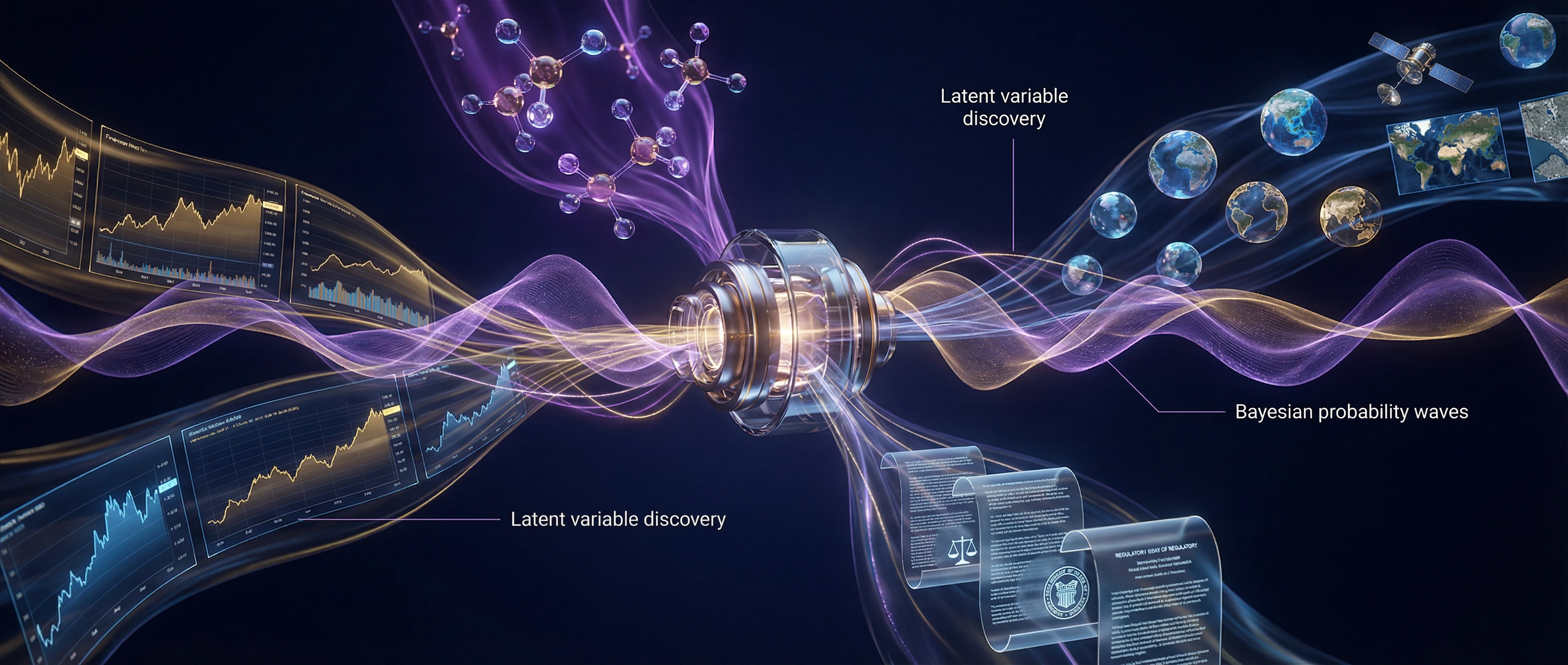
OmniSynth excels at finding the 'unknown unknowns' by fusing disparate data streams into a coherent, predictive whole. It is the core review-based engine for discovering latent market-moving signals.
The Signal Fusion Pipeline
OmniSynth processes data through a multi-stage pipeline, transforming raw, noisy signals into high-fidelity, predictive intelligence. Each stage builds upon the last, culminating in the creation of actionable Trust Domain Indices.
Stage 1
Signal Normalization & Debiasing
OmniSynth ingests and normalizes signals from multi-domain data sources, including financial time series, regulatory events, and telemetry. A debiasing layer corrects for known data biases, ensuring a clean input for fusion.
Key Capabilities
- Multi-domain data fusion
- Signal normalization and debiasing
- Source provenance tagging
- Real-time data ingestion
Stage 2
Deep Ensemble Learning
The core of OmniSynth uses deep ensemble learning techniques to model complex, non-linear relationships between different signals. This allows for the discovery of patterns that are invisible to standard review.
Key Capabilities
- Deep ensemble modeling
- Non-linear relationship discovery
- Cross-silo pattern spotting
- Multi-modal data integration
Stage 3
Weighted Bayesian Modeling
A weighted Bayesian model is applied to the ensemble output. This allows for strong uncertainty measurement and probabilistic forecasting. The model is always updated as new data becomes available.
Key Capabilities
- Weighted Bayesian modeling
- Uncertainty measurement
- Probabilistic forecasting
- Real-time model recalibration
Stage 4
Latent Signal Discovery
OmniSynth is designed to uncover latent variables and hidden signals that drive system behavior. This capability allows for the spotting of before unknown opportunities and risks.
Key Capabilities
- Latent variable discovery
- Hidden signal spotting
- Emergent risk and opportunity review
- Cross-disciplinary insights
Stage 5
Trust Domain Index Creation
The final output is a set of Trust Domain Indices (TDIs). These provide a synthesized, evidence-backed view of the studied domain. Other frameworks consume TDIs for decision-making and governance.
Key Capabilities
- Trust Domain Index (TDI) creation
- Evidence-backed synthesis
- Integration with governance frameworks
- Actionable intelligence output
Core Integration Partners
OmniSynth functions as a core review-based engine within the broader framework ecosystem. It provides essential signal fusion capabilities to its direct integration partners.
Helios
Meta-Governance
Receives Trust Domain Indices from OmniSynth to inform its governance and oversight functions.
V-Framework
Recursive Scenario Mapping
Uses OmniSynth's signal fusion to create more accurate and thorough scenario branches.
PeriodMerge
Temporal Strand Fusion
Aligns the temporal data within OmniSynth's models to ensure coherence across different time horizons.
QNSPR
Evidence Synthesis
Provides provenance-linked evidence to OmniSynth, ensuring all fused signals are traceable and auditable.
OmniSynth in Action
These case studies illustrate how OmniSynth's deep ensemble signal fusion provides a critical advantage in complex, multi-domain scenarios.
MedTech & Aerospace
Cross-Vertical Supply Chain Disruption Detection
Challenge: A rare-earth material shortage was developing in Southeast Asia. It impacted both MedTech device manufacturing and aerospace component production across 6 portfolio companies. Standard monitoring systems tracked each vertical independently and missed the shared dependency.
Solution: OmniSynth's cross-silo fusion spotted the shared rare-earth dependency. It correlated satellite imagery of mining operations, shipping manifest anomalies, commodity pricing signals, and supplier risk feeds across both verticals. The system created a unified impact assessment 3 weeks before standard monitoring detected the issue.
Outcome: Early warning enabled activation of contingency supply chains, mitigating major production delays. Cross-vertical coordination reduced response costs.
Frameworks used
Genomics & Healthcare
Regulatory Convergence Signal Detection
Challenge: Regulatory developments in the EU, US, and Japan were converging toward a unified framework for genomic data. No single-domain review could detect this convergence pattern.
Solution: OmniSynth fused regulatory filing signals from all three jurisdictions with patent activity and clinical trial registries. The cross-domain fusion engine spotted the convergence pattern. It created a 12-month predictive model of likely regulatory harmonization outcomes.
Outcome: Convergence detected months ahead of industry consensus. Portfolio companies repositioned product strategies and gained first-mover advantage.
Frameworks used
Explore Another Framework
OmniSynth is one of 22 proprietary frameworks that form a unified intelligence architecture. Discover how other components contribute to the ecosystem.
Return to Frameworks OverviewOmniSynth Execution Stages
Signal Normalization & Debiasing
OmniSynth ingests and normalizes signals from multi-domain data sources, including financial time series, regulatory events, and telemetry. A debiasing layer corrects for known data biases, ensuring a clean input for fusion.
Use Cases Powered by OmniSynth

Platform Roll-Up Optimization with OmniSynth
OmniSynth orchestrates platform roll-up optimization by synthesizing operational, financial, and cultural data across multiple acquisition targets to identify integration sequences, cross-entity synergies, and harmonization priorities.

Digital Transformation Strategy with OmniSynth
OmniSynth orchestrates portfolio company digital transformation by synthesizing technology, operations, and compliance dimensions into adaptive, scenario-tested modernization roadmaps.

ESG Risk Assessment with ARCF and OmniSynth
ARCF and OmniSynth enable systematic ESG risk identification and continuous monitoring across PE portfolios, producing compliance-sealed assessments that evolve with regulatory regimes and stakeholder expectations.